Plan Your Best Photography Year: 3-Zone Method for 2026 Goals
Stop Setting Goals We'll Abandon by March: Here's What Actually Works
If we've ever set photography goals on January first only to completely abandon them by March, this changes everything. Most photographers fail at their yearly goals not because they lack motivation or talent, but because they're planning like they have endless time and zero responsibilities. They're setting goals as if photography is their only job, their only passion, and their only commitment. Spoiler alert: it's not. And pretending otherwise is exactly why that ambitious shot list and that "post three times a week" promise are collecting dust in our notes app right now.
The 3-Zone Method is a planning framework that actually works when we have a full-time job, a life outside of photography, and approximately zero interest in burning out before February. Down below you'll find a link to a free template to make this three-zone method work for you.

Why Traditional Photography Goal Setting Fails
Here's what typically happens with photography goal setting. We watch a bunch of inspiring videos, we get pumped up, and we create this massive list of everything we want to accomplish. Master portrait lighting. Learn landscape astrophotography. Build a portfolio website. Start a YouTube channel. Pitch to five brands. Sell prints. Learn Lightroom presets. Shoot every single weekend. Post daily on Instagram. And somehow, somehow, also maintain our actual career, our relationships, and our sanity.
That list looks impressive. It feels productive just writing it down. But here's the uncomfortable truth: it's a fantasy. It's a recipe for feeling inadequate every single month when we inevitably can't check off seventeen different goals while working forty-plus hours a week at our real job.
Many of us have spent years doing this. We'd set these elaborate photography goals, feel excited for about two weeks, then watch them slowly suffocate under the weight of project deadlines, life responsibilities, and basic human needs like sleep. The problem wasn't our commitment to photography. The problem was that we were planning like full-time professional photographers when we were actually full-time employees who loved photography.
So there's a different system. Something realistic. Something that actually accounts for the fact that photography, for most of us, shares space with everything else in our lives. That system is the 3-Zone Method.
Zone 1: Skills - Master One Thing Per Quarter
The first zone is skills. This is where most people sabotage themselves immediately. They want to learn everything. Portrait lighting, landscape composition, street photography candids, studio strobes, off-camera flash, color grading, black and white processing, the list goes on forever. And because they're trying to learn everything simultaneously, they end up not actually getting good at anything.
Here's the rule for Zone 1: pick one technical skill or creative technique to focus on per quarter. Just one. That means in an entire year, we're deeply learning four things. Not forty. Four.
Why does this work? Because of something researchers call deliberate practice. A study published in Psychological Review by Anders Ericsson found that expertise doesn't come from dabbling in many things, but from focused, intentional repetition in specific areas. When we concentrate our limited practice time on one skill, we actually build competency. When we scatter it across ten skills, we stay perpetually average at all of them.
Let's look at a practical example. Let's say in Q1 of 2026, our Zone 1 focus is mastering natural light portraits. That's it. For three months, every time we shoot, we're thinking about light direction, quality, and how it shapes faces. We're not also trying to learn astrophotography or product photography or anything else. Just natural light portraits.
By April, we'll actually be noticeably better at reading light. We'll see it differently. We'll position subjects differently. We'll have developed an actual skill, not just surface-level familiarity with twenty different techniques.
Then in Q2, maybe we focus on composition and framing. Q3 could be color grading in post-production. Q4 might be learning off-camera flash. Four focused skills. Four real improvements. And because we're only committing to one thing at a time, it's actually achievable even when we're working full-time.
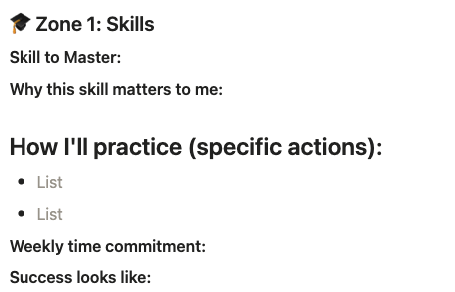
How to Choose Your Zone 1 Skill
When selecting a skill to master, ask ourselves: What's the biggest technical gap holding back our photography right now? What skill, if we mastered it, would unlock new creative possibilities? What have we been wanting to learn but keep putting off because we're distracted by shiny new techniques?
The key is choosing something specific enough to measure progress but broad enough to apply across different shooting scenarios. "Get better at photography" is too vague. "Master natural window light for portraits" is perfect.
Zone 2: Projects - Choose Work That Excites Us
Zone 2 is about projects. This is where we apply our creativity, not just our technical skills. And this is where a lot of photographers fall into the trap of shooting what they think they should shoot instead of what actually excites them.
The rule for Zone 2: pick one personal project per quarter that genuinely interests us. Not what's trending on Instagram. Not what we think will get us followers. What we actually want to create.
Why is this so important? Because when photography becomes just another obligation, another box to check, another thing we're supposed to do for algorithmic approval, it stops being the thing that drew us to it in the first place. When we're creating work we genuinely care about, we're naturally more engaged, more persistent, and more likely to push through challenges. External validation is nice, but it's a terrible primary fuel source for creative work.
Here's how this looks in practice. Maybe in Q1, we want to document our local neighborhood in a photo essay. Not because it's going to go viral. Not because brands are looking for neighborhood content. But because we're curious about the stories in our own community and we want to tell them visually.
Or maybe in Q2, we decide to create a series exploring a specific emotion or concept through portraits. Q3 could be a thirty-day challenge where we shoot only with one focal length to really understand that lens. Q4 might be putting together a year-end photo book of our favorite images.
The key is that these projects matter to us. They're not being driven by external validation. They're being driven by genuine creative curiosity. And here's what's interesting: when we create work that's authentic to what we care about, it tends to resonate more anyway. People can sense when something is made with real intention versus when it's chasing trends.
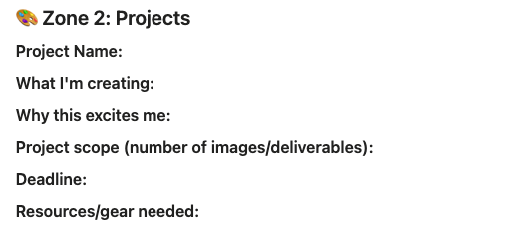
Scoping Projects Realistically
One important note for those of us with full-time jobs: these projects need to be realistically scoped. A personal project doesn't mean we need to shoot a hundred images. It could be ten images. It could be five. The goal isn't volume. The goal is intentional creative work that we actually complete.
Completion matters more than perfection. A finished project of ten images teaches us more and gives us more satisfaction than an abandoned project that was supposed to be fifty images. We're building a habit of following through, not just starting things.
Zone 3: Growth - Set One Tangible Goal
The third zone is growth. This is where we think about expanding our reach, our income, or our opportunities. And just like the other zones, the rule is one focused goal per quarter.
This could be audience growth. It could be income. It could be getting published or featured somewhere. It could be landing our first client or our tenth client. The key is that it's specific, measurable, and actually matters to our version of growth.
Why one goal? Because when we're balancing photography with a career, we have limited bandwidth for business development activities. If we try to simultaneously grow on three platforms, pitch to brands, sell prints, and network with other photographers, we'll do all of it poorly. But if we focus on one growth initiative per quarter, we can actually make meaningful progress.
Let's walk through some examples. In Q1, our Zone 3 goal might be to reach a thousand followers on Instagram. Not because follower count is the ultimate measure of success, but because building an audience opens doors. We're focusing our limited marketing energy on one platform, learning how it works, and building a foundation.
Q2 could be about monetization. Maybe our goal is to book three paid shoots. Or sell five prints. Or land one affiliate partnership. Whatever fits our definition of growth. We're not trying to do all of these. We're picking one and actually executing it.
Q3 might be about getting featured. Our goal could be to submit our work to three photography publications or contests. Or to collaborate with two other creators. Again, one focused growth activity.
Q4 could be launching something. Maybe we finally build that portfolio website. Or we create a photography preset pack. Or we start a newsletter. One thing. Done well.
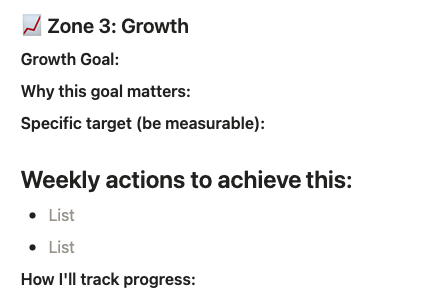
The Difference Between Zone 3 and Zones 1 and 2
Here's what makes Zone 3 different from Zones 1 and 2: this zone often requires consistency and repetition within the quarter, not just skill building or creative output. If our Q1 goal is growing to a thousand followers, that might mean committing to posting twice a week. If it's booking clients, that might mean reaching out to five potential clients every week.
This is where system thinking really helps. We're not just setting a goal. We're identifying the repeatable actions that lead to that goal, and we're scheduling time for them. It's the difference between wishing for growth and engineering it.
Putting the 3-Zone Method Together
So here's what our year looks like with the 3-Zone Method. Every quarter, we have three clear focus areas: one skill to develop, one creative project to complete, and one growth goal to achieve. That's twelve focused commitments over the course of the year instead of an overwhelming list of fifty vague aspirations.
And here's the part that makes this actually work for people with full-time jobs: because we're only focused on three things at a time, we can realistically schedule them. Maybe we dedicate one evening per week to practicing our Zone 1 skill. Maybe Sunday mornings are for our Zone 2 project. Maybe we batch our Zone 3 tasks into one focused session per week.
The 3-Zone Method isn't about doing less because we're lazy. It's about doing less so we can actually do it well. It's about being strategic with limited time. And it's about designing a photography practice that fits our actual life instead of some imaginary version of our life where we have unlimited free time.
Sample 3-Zone Plan for 2026
Here's what a full year might look like:
Q1 (January - March)
Zone 1: Master natural light portraits
Zone 2: Document local neighborhood photo essay (10 images)
Zone 3: Grow Instagram to 1,000 followers
Q2 (April - June)
Zone 1: Learn composition and framing techniques
Zone 2: Create emotion-based portrait series (8 images)
Zone 3: Book three paid portrait sessions
Q3 (July - September)
Zone 1: Master color grading in Lightroom
Zone 2: 30-day single focal length challenge
Zone 3: Submit work to three photography publications
Q4 (October - December)
Zone 1: Learn off-camera flash fundamentals
Zone 2: Create year-end photo book
Zone 3: Launch portfolio website
Notice how each quarter builds on the previous one. The skills we're learning in Zone 1 can be applied to the projects in Zone 2. The work we're creating feeds into our Zone 3 growth goals. Everything connects, but nothing overwhelms.
Why This Works When Traditional Planning Doesn't
The brilliance of the 3-Zone Method is that it acknowledges reality instead of fighting it. We don't have unlimited time. We can't focus on everything simultaneously. We need wins, not just aspirations.
By limiting ourselves to three focus areas per quarter, we're making a strategic choice about where to invest our limited creative energy. We're saying no to distraction and yes to depth. We're building a sustainable practice instead of sprinting toward burnout.
Most photography advice is written for people who do photography full-time or who have way more free time than we do. It's advice for a different life situation. And when we try to apply it to our lives, we end up feeling like we're failing, when really the advice was just never designed for us in the first place.
The 3-Zone Method is different because it starts from the assumption that our time is limited and valuable. It starts from the reality that photography is competing with our career, our relationships, our health, and everything else that matters. And instead of pretending that's not true, it builds a planning system around it.
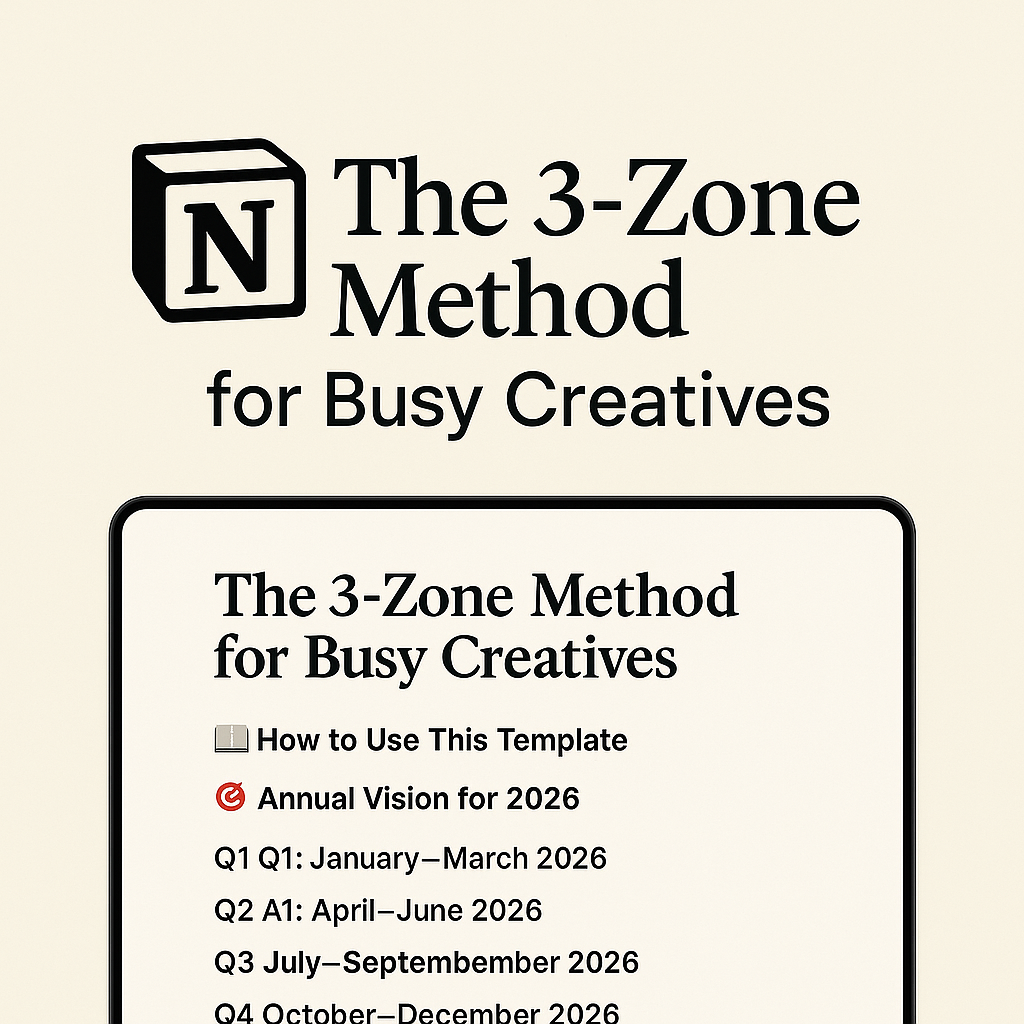
Getting Started with the 3-Zone Method
I've created a free 2026 Photography Planning Template that breaks down the 3-Zone Method for all four quarters. It includes reflection prompts, goal-setting worksheets, and a quarterly review system to keep you on track. You can grab it from the link in the description. It's completely free, and it's designed specifically for photographers who are balancing creative work with everything else life throws at them.
Here's how to start:
Step 1: Audit where we are right now. What skills do we already have? What creative work have we completed? Where are we in terms of audience or income? Honest assessment gives us a baseline.
Step 2: Define what growth means to us. Is it audience? Income? Creative satisfaction? Getting featured? There's no wrong answer, but we need to know what we're optimizing for.
Step 3: Plan Q1 first. Don't try to plan the entire year in detail. Pick our three zones for Q1. Get specific. Make them concrete and measurable.
Step 4: Schedule the work. When will we practice our Zone 1 skill? When will we work on our Zone 2 project? When will we execute our Zone 3 activities? Put it in the calendar.
Step 5: Review and adjust quarterly. At the end of each quarter, review what worked and what didn't. Adjust our approach for the next quarter. The system should evolve with us.
Final Thoughts: Focus Over Fantasy
When we focus on one skill per quarter, we actually get better instead of staying mediocre at everything. When we choose projects that genuinely interest us, we stay motivated instead of burning out on obligation. When we pick one growth goal at a time, we make real progress instead of spinning our wheels on ten different half-efforts.
This isn't about lowering our ambitions. It's about channeling them strategically. It's about setting ourselves up to actually succeed instead of setting ourselves up to feel inadequate every month. And it's about building a sustainable photography practice that can grow alongside our career and our life, not in spite of them.
So as we're planning for 2026, let's ask ourselves: what's one skill we want to master in Q1? What's one project that would excite us? What's one growth milestone that would feel meaningful? Start there. Build our year in zones. And actually finish what we start for once.
The difference between photographers who make steady progress and those who constantly restart isn't talent or time. It's focus. The 3-Zone Method gives us that focus. Now it's up to us to use it.