RICOH GR IV vs GR III: A Real-World Comparison for Street Photographers
The Ricoh GR series has earned its reputation as the pocket powerhouse for street photographers and creative professionals who need a capable camera without the bulk. With the recent release of the GR IV, many of us are facing a tough decision: should we upgrade from our trusty GR III, or if we're starting fresh, which model makes more sense?
After spending considerable time with both cameras in real-world scenarios, we're breaking down the key differences, trade-offs, and situations where each camera shines. This isn't about specs on paper. It's about what actually matters when we're out capturing moments.
The Internal Storage Revolution
Let's start with what might be the most practical upgrade in the GR IV: internal storage. The GR III comes with 2 gigabytes of internal memory, while the GR IV jumps to an impressive 53 gigabytes. At first glance, this might seem like just another spec bump, but the real-world implications run deeper than the numbers suggest.
For those of us who primarily capture JPEGs, the GR III's 2GB has been sufficient for casual outings. JPEGs are relatively small files, and for a quick walk around the neighborhood or spontaneous moments, that built-in storage gets the job done. However, the limitations become apparent when we don't have immediate access to offload our images. Think weekend trips or extended photo walks where we're away from our computers.
The GR IV's 53GB changes the game entirely. This expanded capacity means we can confidently capture RAW files without constantly worrying about running out of space. For photographers who prefer to capture RAW and maintain flexibility in post-processing, this upgrade removes a significant point of friction. We can now leave the house for days without needing to think about storage management.
There's another consideration here: memory card reliability. MicroSD cards, which we'll discuss more later, have a reputation for being less robust than their full-size counterparts. Having substantial internal storage means we can rely less on external cards altogether, reducing one more potential point of failure in our workflow.
Speed, Stabilization, and Low-Light Performance
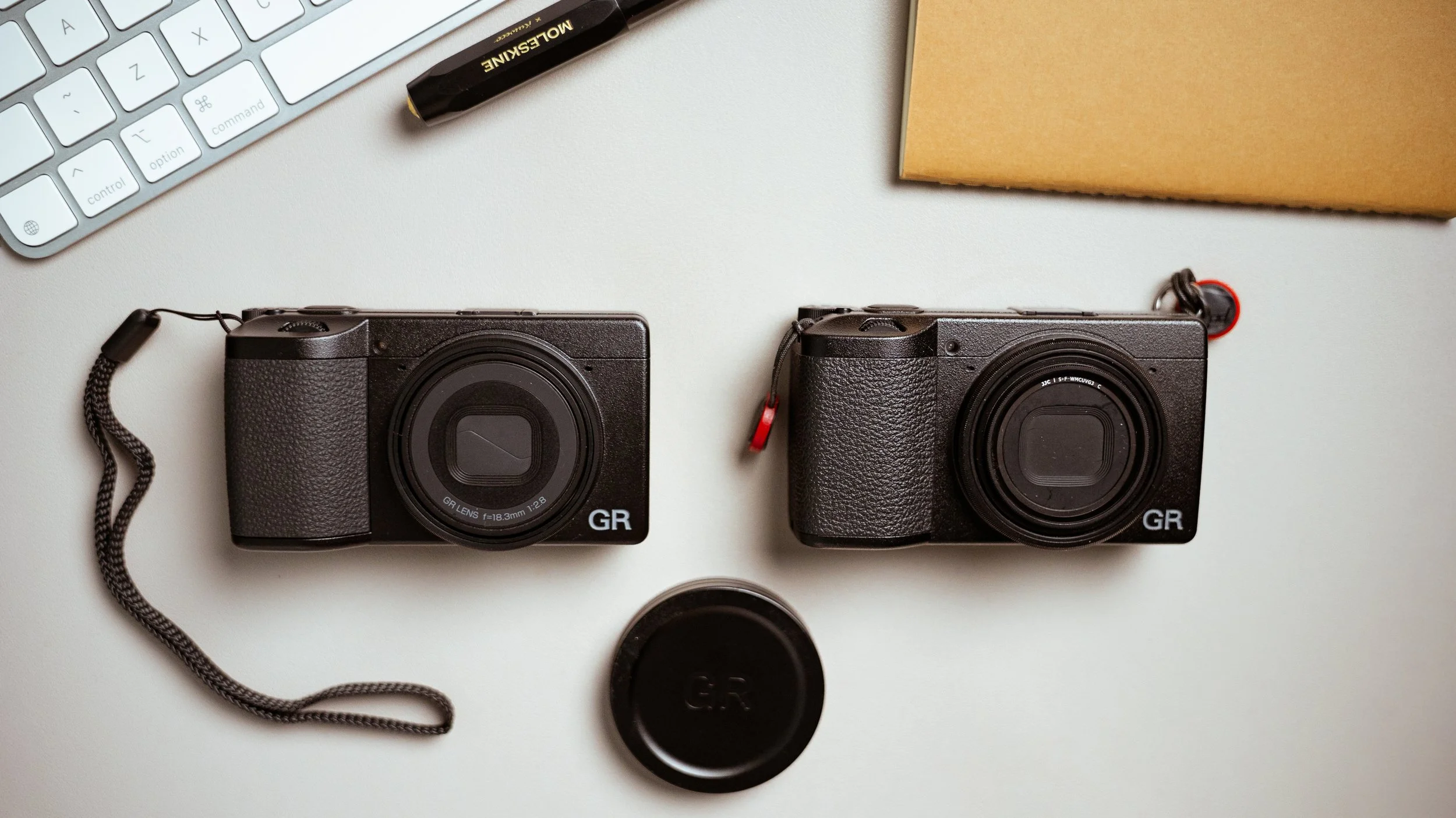
When we talk about capturing those fleeting in-between moments (the quick walk to grab coffee, an unexpected scene during a lunch break, or that perfect light during an evening stroll), camera responsiveness becomes critical. The GR series has always excelled at pocketability, but the GR IV brings meaningful improvements to how quickly we can capture these moments.
The GR III features a three-axis image stabilization system, which has proven more than adequate for most situations. In typical street photography conditions with decent light, we rarely encounter blur issues. The stabilization does its job well, and for many situations, it's genuinely excellent.
The GR IV upgrades to a five-axis stabilization system with up to six stops of compensation. In practical terms, this means better performance when we're working in challenging low-light environments. When we're faced with the choice between slowing our shutter speed (risking blur) or bumping up ISO (introducing grain), better stabilization gives us more flexibility to work with slower shutter speeds while maintaining sharpness.
During our night photography walks with both cameras, the differences became apparent. Setting both cameras to identical low-light settings and comparing the RAW files revealed that the GR IV consistently delivered sharper results in situations where the GR III was beginning to struggle. The images from the GR III weren't bad by any means, but when pixel-peeping, we could see where the camera was hitting its limits with slightly softer results.
The GR IV also benefits from a faster processor, which contributes to quicker startup times and more responsive operation. When we pull the camera from our pocket and power it on while bringing it to our eye, the GR IV is ready to capture by the time we're framing the scene. The GR III isn't slow. In fact, it's been perfectly adequate for most situations we've encountered. But the GR IV feels noticeably more instantaneous.
However, both cameras share a frustrating quirk: occasionally, when we power on the camera and immediately press the shutter, the image doesn't register. We feel the click, hear the shutter, but when we review our images, that capture simply isn't there. This issue persists on both models, which is disappointing to see carry over to the newer version.
The Autofocus Situation
If there's one aspect of the GR III that has consistently tested our patience, it's the autofocus system. For many of us who have spent significant time with the GR III, autofocus has been a persistent source of frustration. We've adapted our shooting style to work around these limitations by switching to snap focus and capturing from the hip, or enabling tap-to-focus and capture for more deliberate compositions.
The face and eye detection features on the GR III have proven unreliable enough that many of us simply stopped using them. For run-and-gun street photography, the autofocus system requires too much hand-holding, often forcing us to slow down or resort to manual focus techniques.
The GR IV shows measurable improvement in this department. During our testing, particularly in challenging low-light scenarios where autofocus typically struggles across all camera systems, the GR IV demonstrated faster and more confident focus acquisition. It locks onto subjects more quickly and requires less intervention from us to achieve sharp results.
When using the LCD screen to focus on subjects that aren't immediately obvious to the camera, the GR IV responds more quickly and accurately. The overall experience feels more polished and reliable. While it's not perfect (no autofocus system is), the improvements are substantial enough to reduce frustration and help us capture moments we might have missed with the GR III.
Trade-Offs and New Friction Points
Not everything about the GR IV represents straightforward improvement. Some changes introduce new considerations and trade-offs that we need to evaluate based on our individual workflows.
The GR IV uses a new battery that provides approximately 250 captures per charge, compared to the GR III's 200. This represents a meaningful improvement, but it also means our existing GR III batteries and chargers become obsolete if we upgrade. For those of us who have invested in multiple batteries and charging solutions, this stings. Despite the improvement, neither camera offers true all-day battery life for extended sessions, so we still recommend carrying spare batteries regardless of which model we choose.
Perhaps the most controversial change is the shift from full-size SD cards to microSD cards. This appears to be a design compromise to accommodate the larger battery in a slightly smaller body. The GR IV is about 2mm more compact, which is surprisingly noticeable in hand. For photographers who rely primarily on the generous internal storage, this change might not matter. However, for those of us who capture predominantly in RAW and need additional storage, microSD cards introduce new friction.
MicroSD cards are fiddlier to handle, easier to lose, and generally feel less robust than full-size SD cards. They typically require adapters or dongles for our computers, adding another piece of equipment to our workflow. From a purely practical standpoint, this feels like a step backward in terms of convenience and reliability.
Ergonomic Evolution
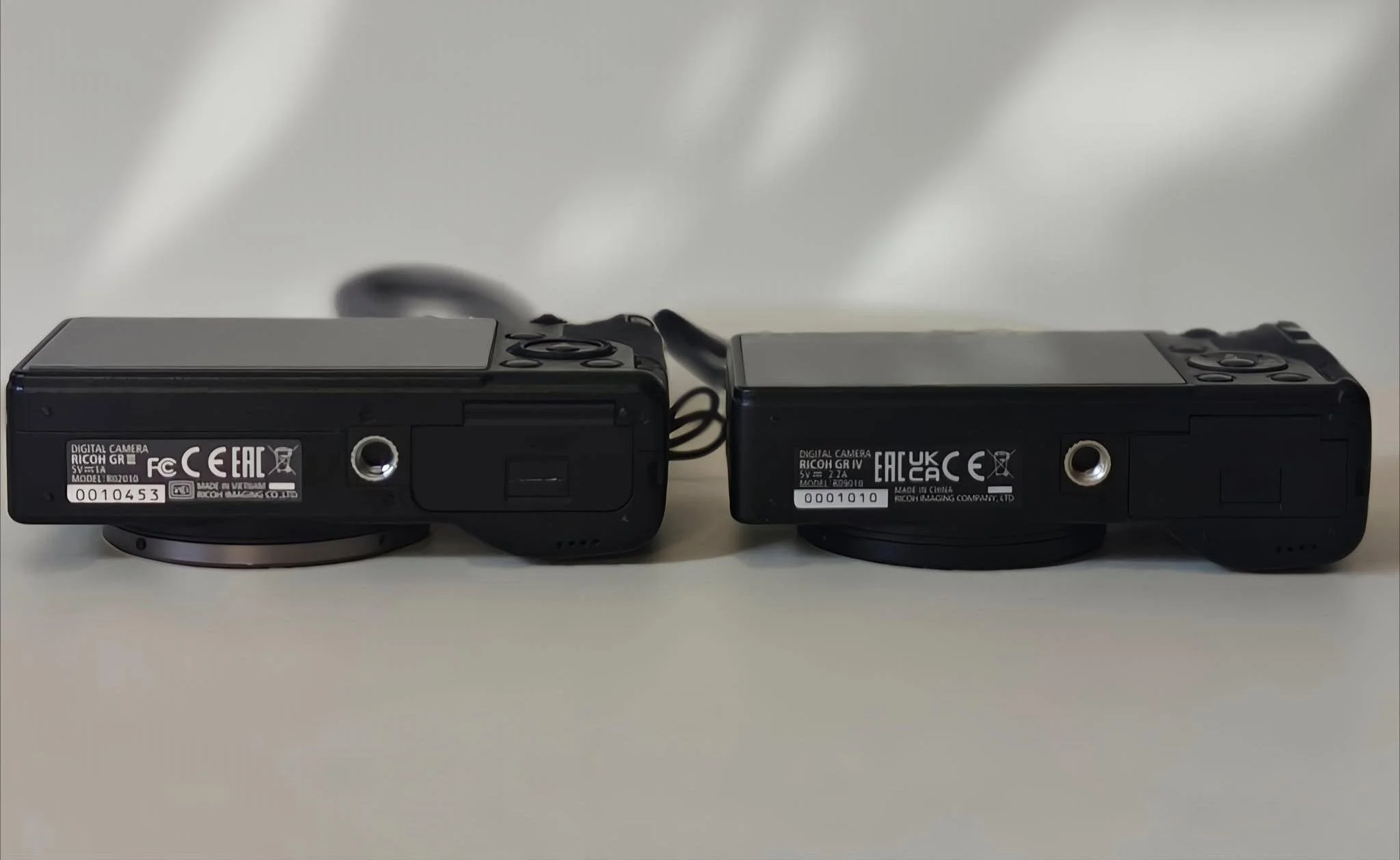
The GR IV maintains the overall form factor that makes the GR series so appealing, but Ricoh has implemented several ergonomic refinements. The most obvious addition is the pair of plus and minus buttons on top of the camera, positioned above the playback button. By default, these control ISO, which creates a more streamlined experience.
For manual work, we can now adjust all three primary exposure settings without diving into menus: the front dial controls aperture, the back dial manages shutter speed, and the new buttons handle ISO. Once we develop muscle memory with these controls, we can make adjustments without taking our eyes off our subject. The time and mental energy saved by not needing to activate ISO adjustments through the directional pad adds up over the course of a session.
The dials themselves have also evolved. The front dial now has a firmer, more deliberate feel, while the back control has transformed from a knob to a dial (which still functions as a button when pressed). These changes require some adjustment period, particularly for those of us accustomed to the GR III's tactile feedback, but they're neither objectively better nor worse. They're just different.
One change that has proven more divisive is the replacement of the GR III's scroll wheel with a traditional directional pad. The scroll wheel on the GR III enabled quick navigation through images and menus with a simple rotation. While the directional buttons on the left, right, up, and down positions of the GR III were often clunky to use, we adapted to the wheel for most navigation tasks.
The GR IV eliminates the scroll wheel entirely in favor of discrete up, down, left, and right buttons. These buttons are more reliable and precise, but we've found ourselves instinctively trying to rotate the non-existent wheel during image review. The buttons require individual presses for each movement, which feels slower for rapid navigation. This represents a trade-off between precision and speed that we're still adjusting to.
Looking Ahead: The HDF and Monochrome Variants
Ricoh has announced additional variants of the GR IV that deserve consideration in our decision-making process. While the monochrome version will appeal specifically to black-and-white photography purists, the HDF (Highlight Diffusion Filter) model presents an intriguing option for a broader audience.
The HDF variant includes a special filter that creates a cinematic, low-contrast aesthetic straight out of camera. Importantly, this effect can be toggled on or off, providing flexibility rather than forcing a specific look. For those of us who prioritize in-camera JPEGs and want to minimize post-processing time, the HDF version could be particularly compelling.
If we're drawn to that filmic aesthetic and want to reduce our editing workload, waiting for the HDF variant might be the smarter choice. This version could save substantial time in the long run by delivering our desired look without additional processing.
Making the Decision
So which camera should we choose? As with most gear decisions, the answer depends on our specific needs and style.
We should stick with the GR III if our photography primarily involves static street scenes in decent lighting conditions, if we've already built a workflow that effectively works around the camera's limitations, or if we've invested in accessories and spare batteries that make our current system complete. The GR III remains a highly capable camera, and if our existing setup is working well, the GR IV's improvements, while nice, may not justify the upgrade cost.
The GR IV makes sense for us if small time optimizations matter and we're willing to pay to reduce friction in our experience. If we frequently miss moments due to autofocus limitations, if we regularly forget memory cards and would benefit from the substantial internal storage, or if we often work in low-light conditions where the improved stabilization makes a real difference, the GR IV addresses these specific pain points.
For those starting fresh without either camera, consider looking for a used GR III as a cost-effective entry point into the GR system. The GR III remains an excellent camera that can teach us the fundamentals of working with this unique compact format. However, if the HDF variant aligns with our aesthetic preferences, it might be worth waiting for that release to make our decision.
Moving Forward with Our Gear
Regardless of which GR camera we choose, the most important step is planning how we'll actually use it. Having capable gear means nothing if we don't develop the systems and habits to put it to work regularly. The technical differences between cameras matter far less than our commitment to getting out and creating consistently.
The best camera is ultimately the one we'll use, the one that fits naturally into our daily routine, and the one that helps us capture the moments that matter. Whether that's the GR III, the GR IV, or the forthcoming HDF variant depends entirely on which features align with how we actually work and what friction points we're most motivated to eliminate.
Take time to honestly assess our style, the conditions we typically encounter, and the specific limitations that hold us back. Then make the choice that addresses those real-world needs rather than chasing specs that look impressive on paper but don't meaningfully improve our experience behind the camera.